Why reason about computation?
Reinforcement learning agents do not become more computationally efficient as they improve. Humans do tasks can require less cognitive effort as we become proficient.
If agents could reason about their computation, could they learn to use computation toward improved performance?
We show that agents can be given actions that control when they use compute perform better and are more efficient to hand-crafted agents.
Method: Using actions to reason about compute
The agent's computational processes were changed by adding actions.
Our method selects an option consisting of an Atari action paired with a duration. The agents processes (seen above) are turned on only for option selection. The processes are off during execution (during action repeats). An agent can learn to change how it processes its stream of experience, saving computational resources.



Results:
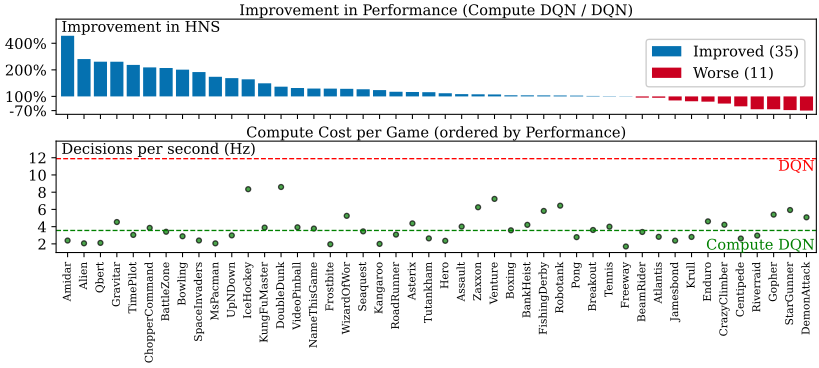
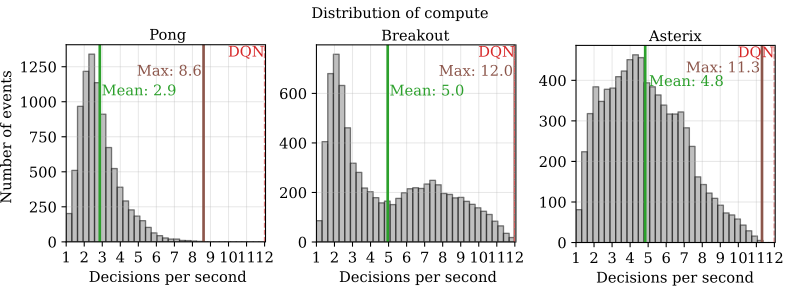
Our method improves in 75% of 46 games, a 233% geometric-mean human-normalised score against DQN's 189%, while averaging 3.6 Hz against DQN's fixed 12 Hz.